Have you ever watched a professional chef effortlessly glide their knife through a pile of vegetables, creating perfectly uniform pieces in seconds, and felt a pang of inadequacy? I certainly have. For years, I believed that truly great knife skills were an innate talent, something you either had or you didn’t. I’d chop, dice, and mince daily, convinced that sheer repetition would eventually transform my clumsy cuts into elegant movements. Yet, after months, even years, my diced onions still resembled a collection of uneven shards, my julienned carrots were perpetually inconsistent, and my fingertips bore the scars of countless near misses. It was frustrating, demoralizing, and frankly, slowed down every single meal I cooked.
What I eventually realized, after much trial and error and a humbling period of unlearning bad habits, was that my approach to practice was fundamentally flawed. It wasn’t about how much I chopped, but how I chopped, and more importantly, what I was focusing on. The biggest mistake I see home cooks make isn’t a lack of effort, but a lack of deliberate practice coupled with a misunderstanding of the foundational principles that underpin true knife mastery. You can chop a thousand onions poorly, and you’ll only get better at chopping onions poorly. What changed everything for me was a structured routine that broke down complex movements into manageable, repeatable steps, focusing on precision and safety before speed.
Key Takeaways
- Your knife skills aren’t improving because you’re practicing without specific technique focus, reinforcing bad habits.
- True improvement stems from mastering the foundational grips and stances before attempting complex cuts.
- Implement a dedicated, short daily practice routine using specific, inexpensive vegetables to build muscle memory.
- Prioritize consistent, even cuts over speed; speed naturally follows precision and confidence.
The Unseen Pitfalls: Why Your Daily Chopping Isn’t Working Wonders
When I first started cooking seriously, I thought the only way to get better with a knife was to just… use it more. My routine was simple: cook dinner, chop ingredients, repeat. But this casual approach masked several critical flaws that kept me stagnant. The mistake I see most often is that people practice without purpose. They’re chopping for a recipe, not for skill development. This leads to a few common, yet debilitating, habits.
Firstly, there’s the inconsistent grip. Most home cooks default to whatever feels comfortable in the moment, rather than adopting a stable, secure grip that provides control. This often means gripping the handle too far back, or using a ‘hammer grip’ that sacrifices fine motor control. Without a consistent, proper grip – like the ‘pinch grip’ where your thumb and forefinger pinch the blade just above the bolster – you can’t achieve repeatable movements or fine precision. Every cut becomes an isolated event rather than a controlled motion, leading to unevenness and increased risk.
Secondly, there’s the neglect of the guiding hand. Your non-dominant hand, often called the ‘claw grip’ hand, is just as crucial as the knife hand. Many just hold the food down flat, exposing their fingertips to danger. The claw grip, with knuckles forward and fingertips tucked back, creates a protective barrier and also acts as a movable guide for consistent slice thickness. Without actively engaging and positioning this hand correctly, you’re not only risking injury but also losing a primary mechanism for achieving uniform cuts.
Finally, and perhaps most insidiously, is the rush to speed. We see chefs on TV and immediately want to emulate their rapid-fire movements. This leads to a frantic, uncontrolled chopping style where precision is sacrificed for velocity. Speed, in my experience, is a byproduct of confidence and precision, not its prerequisite. Attempting to chop fast before mastering control only ingrains sloppy habits, making it harder to correct them later. Instead of focusing on getting through the pile quickly, I now emphasize making each individual cut perfect, knowing that true speed will follow naturally.
The Foundation: Mastering Your Grip and Stance
Before you even think about cutting a carrot, you need to establish a solid foundation. This means understanding and consistently applying the correct knife grip and maintaining an optimal body stance. It sounds overly basic, but I promise you, this is where 90% of home cooks go wrong, and it’s the first step I had to meticulously re-learn.
Let’s talk about the Pinch Grip. This is the single most important grip for control and safety with a chef’s knife. Hold your knife with your thumb on one side of the blade and your forefinger on the other side, pinching the blade just in front of the bolster (the thick part where the blade meets the handle). Your remaining three fingers then wrap around the handle. This grip gives you superior control over the blade’s tip and direction, effectively making the knife an extension of your arm. Practice just holding the knife this way, picking it up, putting it down, feeling the balance. Do this 20-30 times every day for a week without even cutting anything.
Next, the Claw Grip. This is for your non-dominant hand, the one holding the food. Curl your fingertips underneath your knuckles, forming a ‘claw’ shape. Your knuckles should be pressed against the side of the blade, acting as a guide, while your tucked-in fingertips are safely out of the way. As you make each cut, you slide your knuckles back along the blade. This not only protects your fingers but also ensures consistent slice thickness. Practice forming this grip on a cutting board, pressing your knuckles against an imaginary blade, and sliding it back incrementally. Visualizing the knife’s path against your knuckles is key.
Finally, your Stance. Stand comfortably, with your feet about shoulder-width apart, and your dominant foot slightly back. This creates a stable base. Position your body so that you are looking directly down at your cutting board, not craning your neck from the side. The cutting board should be at a height where your arm can move freely without shrugging your shoulders or bending too low. If your counter is too low, get a thicker cutting board or a non-slip mat to raise it. A stable stance reduces fatigue and improves your range of motion, which directly translates to more fluid and controlled cuts.
My Revolutionary 10-Minute Daily Practice Routine
This is the core of what changed everything for me. Instead of hoping my skills would improve through general cooking, I dedicated a small, focused block of time each day solely to knife practice. It doesn’t need to be long; consistency and focused effort are far more important than marathon sessions.
The Routine (10 minutes daily, 5-6 days a week):
Preparation (1 minute): Get a sharpened chef’s knife, a stable cutting board, and one or two inexpensive, easy-to-cut vegetables. My go-to choices are carrots, celery, and onions. Avoid slippery tomatoes or delicate herbs when you’re starting. A small bowl for scraps and a plate for finished cuts. Set a timer for 10 minutes.
Warm-up & Grip Check (1 minute): Pick up your knife, consciously establish the pinch grip. Form your claw grip with your non-dominant hand. Take a few deep breaths. Feel the knife’s balance. Remember: precision over speed.
Carrot Rounds (2 minutes): Take a peeled carrot. Using your claw grip, make perfectly even rounds, about 1/8 to 1/4 inch thick. Focus on a smooth, controlled downward and forward motion. The tip of the knife should stay on the board, pivoting up and down. Do not rush. If a cut isn’t even, don’t discard it, just observe and try to correct the next one. The goal is uniformity.
Celery Dice (3 minutes): Take a stalk of celery. First, cut it into 2-3 inch sections. Then, cut each section lengthwise into consistent strips (julienne). Finally, stack a few strips and cut across to create small, even dice. This exercises both your slicing and dicing control. Again, the claw grip is your best friend here, guiding each cut. Ensure your dice are as square and uniform as possible.
Onion Brasseuse (3 minutes): Cut an onion in half, root end intact. Place one half flat on the board. Make horizontal cuts towards the root, but not through it. Then make vertical cuts, also towards the root. Finally, slice across to create small, even dice. This is a crucial technique for onions and requires precise control of the blade’s angle and your guiding hand. The root end is your anchor; it holds the onion together.
Key Principle: After each practice session, observe your cuts. Are they uniform? Are they consistent? Don’t beat yourself up about imperfections, just acknowledge them and focus on improvement in the next session. This deliberate observation is what turns mere repetition into skill development.
The Power of Sharpening and Knife Maintenance
This might seem like a tangent, but I guarantee it’s not. A dull knife is not just frustrating; it’s dangerous. When your knife is dull, you compensate by applying more force, which leads to less control, increased slippage, and a higher risk of injury. It also makes achieving clean, precise cuts nearly impossible. Imagine trying to write a beautiful letter with a blunt pencil – it’s an uphill battle.
In my experience, many home cooks drastically underestimate the importance of a truly sharp knife. I used to think ‘sharp enough’ was fine. It wasn’t. A truly sharp knife glides through ingredients with minimal effort. This reduces fatigue and allows you to focus on technique rather than brute force.
My sharpening routine:
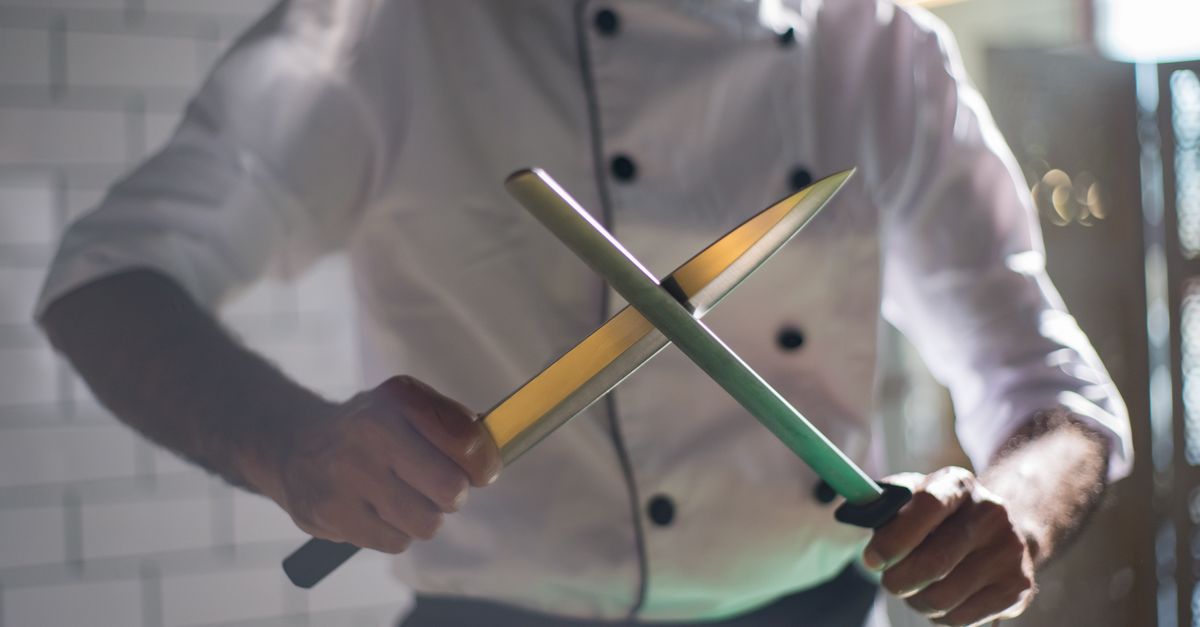
- Honing Steel (daily/before each use): This doesn’t sharpen your knife but realigns the microscopic edge of the blade, keeping it keen. A few gentle strokes (3-5 per side, alternating) at a consistent angle will make a noticeable difference in how your knife performs during a session.
- Whetstone (monthly/bi-monthly): This is where true sharpening happens. Learning to use a whetstone can seem intimidating, but it’s a game-changer. I invested in a simple two-sided whetstone (1000/6000 grit) and watched a few YouTube tutorials. Start with cheap knives if you’re nervous. The feeling of a truly sharp knife after using a whetstone is incredibly satisfying and will immediately translate into better, safer cuts.
- Professional Sharpening (yearly): Even with regular honing and whetstone use, a professional sharpening can restore a knife’s edge to its factory best. Consider this an annual tune-up for your most important kitchen tool.
Treating your knife like a precision instrument, rather than just a kitchen tool, fosters respect for the craft and drastically improves your cutting experience.
Prioritizing Precision Over Speed: The Unintuitive Path to Mastery
I used to clock how fast I could dice an onion. I’d race through a pile of carrots, feeling a rush of accomplishment only to find my cutting board littered with irregular shapes. It was a classic example of confusing activity with progress. The biggest breakthrough in my own knife skill journey was deliberately slowing down and prioritizing absolute precision in every single cut.
When you focus on making each individual slice, dice, or chop perfectly even and consistent, a few things happen. First, your muscle memory begins to solidify the correct movements without the added pressure of speed. You’re teaching your hands and eyes exactly what a ‘perfect’ cut feels and looks like. This forms a strong neural pathway for proper technique.
Second, by removing the speed variable, you free up mental bandwidth to concentrate on the subtleties: the angle of your blade, the pressure of your guiding hand, the rhythm of your rocking motion. You can actively observe where you’re going wrong and make immediate micro-corrections, which is the essence of deliberate practice.
Third, and most surprisingly, is how quickly speed naturally develops once precision is achieved. Think about a concert pianist who practices scales slowly and deliberately before attempting a concerto at full tempo. The precision allows for fluid, confident movements. Once your hands know exactly what to do, the speed comes almost unconsciously, as your brain trusts your body to execute the correct motion without hesitation. I found that within a few months of this ‘slow and steady’ approach, my cutting speed had not only caught up to my previous rushed pace but had surpassed it, all while maintaining significantly higher consistency and uniformity in my cuts. It’s a counter-intuitive approach that truly works.
Frequently Asked Questions
Q1: What’s the single most important thing I can do to improve my knife skills today?
A1: Adopt and consistently use the pinch grip for your dominant hand and the claw grip for your non-dominant hand. These two fundamental grips are the foundation for safety, control, and precision. Practice them even without cutting anything until they feel natural.
Q2: How often should I practice, and for how long?
A2: Aim for 10-15 minutes, 5-6 times a week. Consistency and focused effort in short bursts are far more effective than infrequent, long, unfocused sessions. Treat it like a mini-workout for your hands and mind.
Q3: Do I need expensive knives to get good at cutting?
A3: Absolutely not. While a good quality knife is a pleasure to use, excellent knife skills can be developed with a moderately priced, sharp chef’s knife. The key is that it’s sharp and you’re using proper technique. Focus your investment on a good sharpening stone and practice vegetables first.
Q4: My cuts are still uneven. What am I doing wrong?
A4: Uneven cuts usually point to one of two issues: an inconsistent guiding hand (claw grip) or an inconsistent blade angle/motion. Ensure your knuckles are firmly pressed against the blade as a guide, and focus on maintaining the same angle throughout each cut. Slow down drastically, even to a crawl, and really observe each movement. Often, the problem resolves when you remove the pressure of speed.
Q5: How do I overcome the fear of cutting myself?
A5: Fear is natural, and it’s your body’s way of telling you to be careful. The best way to overcome it is to master the proper safety grips, especially the claw grip, which physically protects your fingertips. Start with very slow, deliberate movements. Knowing how to protect yourself builds confidence. A sharp knife, paradoxically, is also safer than a dull one because it requires less force and is less prone to slipping.
Improving your knife skills is not about magic or innate talent; it’s about deliberate, focused practice and a fundamental understanding of technique. I spent years making the same mistakes, thinking sheer repetition would lead to mastery. It didn’t. What did, was a humble return to the basics: mastering grip, embracing the slow pace of precision, and maintaining a truly sharp blade. If you commit to this structured approach, even for just 10 minutes a day, you’ll be astonished by how quickly your confidence grows and your cuts transform from clumsy to controlled. Your cooking will become faster, more enjoyable, and the quality of your meals will visibly improve. It’s an investment in yourself that pays dividends with every dish you prepare.


